

Key Takeaways
- More than 1 in 4 adults aged 65 and older fall each year in the United States (CDC, 2024)
- Falls are the leading cause of fatal and nonfatal injuries among older adults (CDC, 2024)
- The fall death rate among older adults increased 21% between 2018 and 2024 (CDC, 2024)
- Most falls result from multiple interacting risk factors — and most are preventable
- Exercise — particularly balance and strength training — is the most strongly supported non-pharmacological intervention for fall prevention (Colón-Emeric et al., 2024)
- Occupational therapy home assessment and modification reduces fall risk and improves ADL safety (Caña-Pino & Pesado-Fernández, 2025)
Important
The information on this page is educational only and is not a substitute for a clinical evaluation or individualized therapy recommendations. If you or someone you care for has fallen or is at risk of falling, speak with a qualified healthcare professional.
Table of Contents
- What Is Fall Prevention and Why Does It Matter?
- Understanding Fall Risk Factors
- Fall Risk Screening and Assessment
- Who Provides Fall Prevention Services?
- Occupational Therapy and Home Safety
- Exercise for Fall Prevention
- Home Modifications and Environmental Safety
- Fear of Falling
- Medications and Fall Risk
- What Families and Caregivers Can Do
- A Note for Clinicians
- References
1. What Is Fall Prevention and Why Does It Matter?
A fall is defined as an unintentional event in which a person comes to rest on the ground, floor, or lower level. For older adults, falls are not an inevitable part of aging — they are a public health problem with well-established risk factors and effective, evidence-based prevention strategies.
Falls are the leading cause of fatal and nonfatal injuries among adults aged 65 and older in the United States. More than 14 million older adults — approximately 1 in 4 — report falling each year, and about 37% of those who fall sustain an injury requiring medical attention (CDC, 2024). The fall-related death rate among adults aged 65 and older rose 21% between 2018 and 2024, reaching 78.4 per 100,000 older adults (CDC, 2024). Approximately 3 million emergency department visits are attributed to older adult falls each year, along with nearly 1 million hospitalizations.
Beyond the physical injuries — which include hip fractures, traumatic brain injury, and soft tissue injuries — falls carry significant psychological and functional consequences. Fear of falling, reduced activity, social withdrawal, and loss of independence are common sequelae (outcomes) even among those who fall without physical injury. Falls are one of the leading drivers of nursing home admissions and long-term care needs in older adults (Colón-Emeric et al., 2024).
The good news is that most falls are preventable. Evidence clearly supports targeted intervention across multiple domains — exercise, home modification, medication review, and balance assessment — particularly when these approaches are combined and individualized.
2. Understanding Fall Risk Factors
Falls rarely result from a single cause. They typically occur when multiple risk factors — intrinsic (within the person) and extrinsic (in the environment) — combine to exceed an individual’s capacity to maintain balance and recover from a perturbation (stumble or slip). Understanding these factors is the foundation of effective fall prevention.
Intrinsic risk factors (related to the individual) include:
- Gait and balance impairment — the most consistently identified fall predictor (Colón-Emeric et al., 2024)
- Muscle weakness, particularly in the lower extremities
- Previous fall history — those who have fallen once are significantly more likely to fall again
- Reduced vision or uncorrected visual impairment
- Orthostatic hypotension (a drop in blood pressure upon standing, causing dizziness)
- Cognitive impairment affecting attention and dual-task performance (doing two things at once)
- Fear of falling, which often leads to activity restriction and further deconditioning (physical decline)
- Chronic conditions including Parkinson’s disease, stroke, arthritis, and diabetes
- Urinary urgency or incontinence, which may lead to rushed movement
Extrinsic risk factors (in the environment) include:
- Clutter, loose rugs, and low furniture in the home
- Poor lighting, particularly on stairs and in hallways
- Absence of grab bars in bathrooms
- Unsafe footwear — loose slippers, high heels, or worn-out soles
- Wet or uneven floor surfaces
- Medications that affect balance, alertness, or blood pressure
Evidence consistently shows that addressing multiple risk factors simultaneously — rather than targeting one in isolation — produces the greatest reduction in falls (Pillay et al., 2024).
3. Fall Risk Screening and Assessment
Clinical guidelines recommend that all adults aged 65 and older be asked annually about falls and fall-related concerns. Those who report a fall in the past year, express concern about falling, or show signs of gait or balance difficulty should receive a more comprehensive fall risk assessment (Colón-Emeric et al., 2024).
Several standardized tools are used to screen and assess fall risk:
- Timed Up and Go (TUG): Measures the time to rise from a chair, walk 3 meters, turn, and return to sitting. A score of 12 seconds or more suggests increased fall risk.
- Berg Balance Scale: A 14-item assessment of static and dynamic balance across everyday tasks.
- 4-Stage Balance Test: A quick clinical screen used by the CDC’s STEADI (Stopping Elderly Accidents, Deaths & Injuries) program.
- 30-Second Chair Stand Test: Measures lower extremity strength and endurance by counting how many times a person can rise from a chair in 30 seconds.
- STEADI Algorithm: A CDC-developed clinical pathway for screening, assessing, and intervening with at-risk older adults.
A comprehensive fall risk assessment goes beyond balance tests. It also includes medication review, vision assessment, home environment evaluation, and review of medical conditions that contribute to fall risk (Colón-Emeric et al., 2024).
For Clinicians
- Gait speed below 0.8–1.0 m/s is a clinically meaningful threshold for fall risk identification and should trigger further assessment.
- The TUG with a concurrent cognitive task (dual-task TUG) more reliably predicts fall risk than the standard TUG alone — cognitive-motor interference is a key but often underassessed contributor.
- Ask specifically about near-falls and fear of falling — these are strong predictors of future falls that patients often do not volunteer.
- Fall risk assessment is most useful when it leads directly to an individualized, documented prevention plan with referral to appropriate disciplines.
4. Who Provides Fall Prevention Services?
Effective fall prevention requires a multidisciplinary (many-specialist) approach because falls result from multiple interacting factors. No single discipline can address all of them.
- Occupational therapy (OT): Home hazard assessment, ADL safety, adaptive equipment, and activity modification
- Physical therapy (PT): Balance training, gait retraining, strength programs, and exercise prescription
- Primary care physician or geriatrician: Medication review, management of underlying conditions, and care coordination
- Pharmacist: Identifying high-risk medications that increase fall risk
- Ophthalmologist or optometrist: Vision assessment and correction
- Podiatrist: Foot and footwear assessment
Evidence strongly supports multifaceted (multi-component) interventions. A large systematic review and meta-analysis found that multifaceted fall prevention programs reduced fall rates by 25% compared to usual care, with the greatest reductions seen when exercise was combined with home hazard assessment and other individualized components (Pillay et al., 2024).
5. Occupational Therapy and Home Safety
Occupational therapists (OTs) are uniquely positioned in fall prevention because they assess both the person and the environment — evaluating how an individual’s physical and cognitive abilities interact with the demands of their home and daily activities. This person-environment fit is central to understanding and reducing fall risk.
OT fall prevention interventions include:
- Home hazard assessment: Systematic evaluation of the home for fall risks including lighting, floor surfaces, bathroom safety, stair access, and furniture arrangement
- Home modification recommendations: Grab bars, raised toilet seats, non-slip mats, improved lighting, stair rails, and removal of clutter and loose rugs
- ADL safety training: Teaching safer techniques for bathing, dressing, transferring (moving from one surface to another), and kitchen tasks
- Adaptive equipment: Long-handled reachers, bath seats, and other tools that reduce the need for risky movements
- Activity modification: Helping individuals adapt high-risk activities to maintain independence safely
- Caregiver education: Training family members in safe assistance techniques and environmental setup
A 2025 systematic review of OT-based multimodal fall prevention interventions found improvements in balance, functional performance, and fall-related confidence across a range of intervention types, with environmental and exercise-based approaches showing the strongest outcomes when combined (Caña-Pino & Pesado-Fernández, 2025).
For Patients & Families
- An OT can come to your home and identify hazards you may not notice — this is one of the most effective fall prevention strategies available
- Small home changes — a grab bar, better lighting, removing a rug — can make a significant difference
- OT isn’t just for people who have already fallen — an assessment is valuable for anyone who wants to stay safe and independent at home
- Ask your doctor for an OT referral, or contact your local home health agency
6. Exercise for Fall Prevention
Exercise is the most strongly supported non-pharmacological intervention for fall prevention in older adults. It is recommended across all major clinical guidelines and supported by a large body of randomized controlled trial evidence (Colón-Emeric et al., 2024; Sadaqa et al., 2023).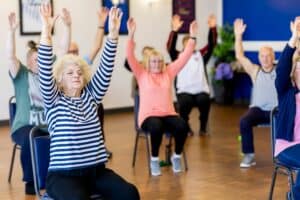
The most effective exercise programs for fall prevention share key characteristics: they challenge balance, are performed regularly (at least 3 hours per week on an ongoing basis), and are progressive — meaning they become more difficult over time as fitness improves. Exercise that only focuses on strength or cardiovascular fitness without balance challenge has weaker evidence for fall reduction specifically.
Evidence-supported exercise approaches include:
- Balance training: Standing on one foot, tandem (heel-to-toe) walking, weight shifting, and reduced-base-of-support exercises
- Strength training: Particularly targeting the lower extremities — quadriceps, hip abductors, and ankle muscles — which are critical for recovery from stumbles
- Tai Chi: A mind-body exercise with strong evidence for improving balance and reducing falls in community-dwelling older adults
- The Otago Exercise Programme: A home-based, individually tailored strength and balance program with robust evidence across multiple randomized trials
- Multicomponent programs: Programs combining balance, strength, and functional movement — such as the Falls Management Exercise Programme (FaME) — demonstrate the highest effectiveness in network meta-analyses (Sadaqa et al., 2023)

Walking programs alone, while beneficial for overall health, are not sufficient to reduce fall risk and should not be the sole exercise strategy for those at high fall risk (Colón-Emeric et al., 2024).
For Patients & Families
- Starting an exercise program — even at an advanced age — can meaningfully reduce fall risk
- Tai Chi is an excellent option for older adults who prefer group-based, low-impact activity
- A physical therapist can design a safe, personalized program matched to your current ability level
- Consistency matters more than intensity — a moderate program done regularly is more effective than occasional vigorous exercise
- Community programs such as YMCA fall prevention classes, Matter of Balance, and Tai Chi for Health are widely available and free or low-cost
For Clinicians
- Exercise programs should challenge balance sufficiently to drive adaptation — programs rated as “no effort” or “a little effort” by participants are unlikely to reduce fall risk meaningfully.
- Assess exercise tolerance, cardiac history, and orthopedic limitations before prescribing a balance and strength program.
- The Otago Exercise Programme has a freely available protocol and has been validated for home delivery by physical therapists or trained community workers — it is appropriate for patients with moderate fall risk who have limited access to group programs.
- Document medication “on/off” state when assessing gait and balance in patients with Parkinson’s disease, as motor performance varies substantially.
7. Home Modifications and Environmental Safety
Environmental hazards contribute to a substantial proportion of falls, particularly in the home — where most falls occur. Home modification is a key evidence-based component of fall prevention, especially when paired with exercise and ADL (activities of daily living) safety training.
High-priority areas for home modification include:
Bathroom:
- Grab bars installed at the toilet and inside the shower or tub — these are one of the highest-yield single modifications
- Non-slip mat inside the tub or shower
- Shower chair or tub transfer bench for those with limited standing tolerance
- Raised toilet seat if getting up from a low seat is difficult
Floors and pathways:
- Remove or secure loose rugs — especially at entry points, bathrooms, and beside the bed
- Clear pathways of clutter, electrical cords, and low furniture
- Ensure floors are not slippery when wet
Lighting:
- Nightlights in hallways, bathrooms, and near the bed for nighttime navigation
- Ensure adequate lighting on all stairways
- Light switches accessible at top and bottom of stairs
Stairs and steps:
- Handrails on both sides of all stairways, extending the full length of the stairs
- High-contrast tape on the edges of steps to improve visibility
Bedroom:
- Bed at appropriate height for safe transfers (getting in and out)
- Clear path from bed to bathroom, especially at night
- Phone accessible from the bed
Evidence supports home-hazard assessment combined with modification as an effective fall prevention strategy, particularly for individuals with a history of falls and those who are homebound (Pillay et al., 2024; Caña-Pino & Pesado-Fernández, 2025).
8. Fear of Falling
Fear of falling is a significant and often overlooked component of fall risk. It affects an estimated 20–85% of older adults — including many who have never fallen — and can lead to a self-reinforcing cycle of reduced activity, deconditioning (physical decline from inactivity), further balance impairment, and increased actual fall risk (Colón-Emeric et al., 2024).
Fear of falling is associated with reduced participation in daily activities, social isolation, depression, and diminished quality of life. It is not simply an emotional response — it reflects a rational awareness of instability that, when addressed effectively, can improve both confidence and safety.
Evidence-based approaches to managing fear of falling include:
- Progressive balance and strength exercise, which builds actual physical stability and self-efficacy (confidence in one’s ability)
- Matter of Balance, a structured group program specifically designed to reduce fear of falling and increase activity participation
- Cognitive-behavioral approaches that identify and modify unhelpful beliefs about falls and activity
- Occupational therapy to identify and address activity-specific fears through graded task practice and environmental modification
For Patients & Families
- Fear of falling is real and valid — but avoiding activity because of that fear often makes the problem worse over time
- Telling a clinician “I’m afraid of falling” is just as important as reporting an actual fall
- Programs like Matter of Balance are free, widely available, and specifically designed to help with this — ask your doctor or local Area Agency on Aging about programs near you
9. Medications and Fall Risk
Medication use is one of the most important and most modifiable fall risk factors in older adults. Multiple medication classes are associated with significantly increased fall risk, including psychotropic medications (those affecting the brain and nervous system) such as sedatives, antidepressants, and antipsychotics, as well as blood pressure medications, diuretics (water pills), and certain pain medications (Colón-Emeric et al., 2024).
Polypharmacy — the use of four or more medications simultaneously — is common in older adults and multiplies fall risk. Medication review by a physician or pharmacist should be part of any comprehensive fall risk assessment. Deprescribing (carefully reducing or stopping unnecessary medications under medical supervision) has been shown to reduce fall rates in some populations.
Individuals should not stop or adjust medications on their own. Any concerns about medications and fall risk should be discussed with a prescribing clinician or pharmacist.
For Clinicians
- Benzodiazepines, Z-drugs (sleep medications), antipsychotics, tricyclic antidepressants, and opioids carry the highest fall risk and should be reviewed routinely in older adult patients.
- Review the complete medication list — including over-the-counter medications and supplements — at every fall-related clinical encounter.
- Orthostatic vital signs should be routinely checked in older adults with fall history, dizziness, or blood pressure medication use.
- When deprescribing is not feasible, timing modifications (e.g., taking diuretics earlier in the day) may reduce fall-relevant side effects.
10. What Families and Caregivers Can Do
Family members and caregivers play a critical role in fall prevention — both in identifying risk and in supporting the changes needed to reduce it. Many older adults are reluctant to disclose falls to their healthcare providers, fearing that a fall report may lead to loss of independence or driving privileges. Family members can help by maintaining open, non-judgmental conversations about safety.
Practical steps families and caregivers can take:
- Walk through the home and look for hazards — loose rugs, poor lighting, cluttered pathways, absence of grab bars
- Encourage and support regular exercise, including accompanying an older adult to a balance or fitness class
- Help manage medications — keep an updated medication list and raise concerns with the prescribing clinician
- Ensure vision and hearing are checked regularly
- Talk openly about fears of falling — normalizing the conversation makes it easier to seek help
- Ensure the person has a way to call for help if they fall — a personal emergency response system or nearby phone
- Support — rather than take over — independence, allowing the person to attempt activities safely before offering assistance
When to Request a Therapy Referral
- Following any fall — even one without injury — to assess what contributed and prevent recurrence
- When an older adult reports being afraid of falling or has started avoiding activities because of fall concerns
- When balance, gait, or coordination has changed or feels less reliable
- After a hospitalization, illness, or surgery — which can cause rapid deconditioning and increase fall risk
- When daily tasks like bathing, dressing, or using stairs feel unsafe or require assistance
- When a home environment assessment has never been performed
- When vision, hearing, or cognition has changed and daily safety is a concern
- At any point when an older adult or family member has a concern about falling — early referral is always appropriate
11. A Note for Clinicians
Fall prevention is most effective when it is treated as a clinical priority — not as a supplemental concern addressed only after a serious fall has occurred. Screening, assessment, and intervention initiated before a fall produces better outcomes than reactive management after injury.
Multifactorial intervention — combining exercise, home modification, medication review, and addressing sensory and cognitive contributors — consistently outperforms single-component approaches in systematic reviews. The evidence is strongest for individualized programs based on clinical assessment rather than generic fall prevention advice (Pillay et al., 2024; Colón-Emeric et al., 2024).
Fear of falling, activity restriction, and social withdrawal are under-documented sequelae of fall risk that significantly affect quality of life and contribute to a cycle of deconditioning. Screening for fear of falling — using tools such as the Falls Efficacy Scale-International (FES-I) — provides clinically important information beyond what fall history alone reveals.
Timely referral to occupational therapy for home assessment and to physical therapy for balance and strength programming remains one of the most impactful and underutilized interventions available in primary care. A 2025 systematic review confirmed that OT-led multimodal interventions improve balance, functional performance, and psychological outcomes related to fall risk across multiple domains (Caña-Pino & Pesado-Fernández, 2025).
12. References
- Caña-Pino, A., & Pesado-Fernández, L. (2025). Occupational therapy interventions for fall prevention in older adults: A systematic review of multimodal strategies. Physiologia, 5(3), 33. https://doi.org/10.3390/physiologia5030033
- Centers for Disease Control and Prevention. (2024). Older adult fall prevention: Data and statistics. National Center for Injury Prevention and Control. https://www.cdc.gov/falls/data-research/index.html
- Colón-Emeric, C. S., McDermott, C. L., Lee, D. S., & Berry, S. D. (2024). Risk assessment and prevention of falls in older community-dwelling adults: A review. JAMA, 331(16), 1397–1406. https://doi.org/10.1001/jama.2024.1416
- Kakara, R., Bergen, G., Burns, E., & Stevens, M. (2023). Nonfatal and fatal falls among adults aged ≥65 years — United States, 2020–2021. MMWR Morbidity and Mortality Weekly Report, 72, 938–943. https://doi.org/10.15585/mmwr.mm7235a1
- Pillay, J., Gaudet, L. A., Saba, S., Vandermeer, B., Ashiq, A. R., Wingert, A., & Hartling, L. (2024). Falls prevention interventions for community-dwelling older adults: Systematic review and meta-analysis of benefits, harms, and patient values and preferences. Systematic Reviews, 13(1), 289. https://doi.org/10.1186/s13643-024-02681-3
- Sadaqa, M., Németh, Z., Makai, A., Prémusz, V., & Hock, M. (2023). Effectiveness of exercise interventions on fall prevention in ambulatory community-dwelling older adults: A systematic review with narrative synthesis. Frontiers in Public Health, 11, 1209319. https://doi.org/10.3389/fpubh.2023.1209319
© TherapyTopics.com — All information is for educational purposes only and does not constitute medical or therapeutic advice. Consult a licensed therapist or physician for evaluation and treatment.