

Key Takeaways
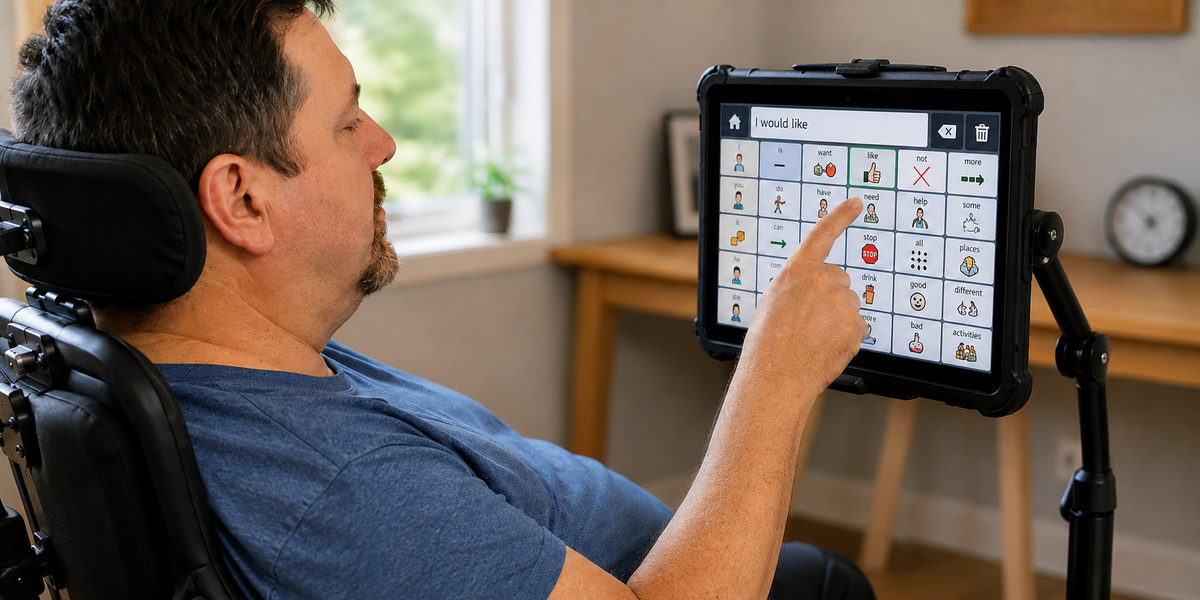
- Augmentative and alternative communication, or AAC, includes any tool or method that helps someone communicate when speech alone is not enough (Aftab et al., 2023).
- AAC can be low tech, like a picture board, or high tech, like a speech generating device (Aftab et al., 2023).
- There is no age too young to start. A systematic review of children ages 0 to 6 found AAC can be introduced as soon as a communication need is identified, not only after speech has clearly failed to develop (Leonet et al., 2022).
- Studies show AAC can help children with autism build communication skills, and it does not stop children from talking (Ganz et al., 2023).
- Occupational therapy and physical therapy play a real role in AAC through seating, positioning, and access, so a person can physically reach and use their device (Coan-Brill et al., 2025; Caron et al., 2025).
- AAC can also support adults recovering from a stroke and people living with ALS, not just children (Huang et al., 2025; Judge et al., 2026).
- Communication partners, like family members and caregivers, matter just as much as the device itself (Hanley et al., 2023).
- A team that includes speech therapy, occupational therapy, and physical therapy tends to get the best results for people who use AAC (Caron et al., 2025).
Table of Contents
- What Is AAC?
- Who Uses AAC, by Age and Population
- Types of AAC
- Who Provides AAC Services?
- How an AAC Evaluation Works
- Funding and Device Abandonment
- Speech Therapy for AAC
- Occupational Therapy and Physical Therapy: Positioning and Access
- AAC for Aphasia After Stroke
- AAC for ALS
- The Role of Communication Partners
- Team Collaboration in Schools
- What Patients and Families Can Do
- A Note for Clinicians
- When to Seek a Referral
1. What Is AAC?
Augmentative and alternative communication, or AAC, means any tool, method, or strategy that helps a person communicate when speech alone does not meet their needs. The word augmentative means it adds to the speech someone already has. The word alternative means it replaces speech when someone has little or none. AAC can be as simple as pointing to pictures on a board, or as complex as a computer that speaks words out loud when the person selects them (Aftab et al., 2023).
AAC is not just for children. It is used across the lifespan, from toddlers to older adults, and across many different conditions.
2. Who Uses AAC, by Age and Population
AAC supports people across a wide age range and a wide range of conditions. What AAC looks like, and how urgently it should be introduced, differs depending on the person’s age and situation.
Infants and young children (0 to 6 years): A 2022 systematic review of 29 studies found AAC interventions were effective across this age group for children with a range of diagnoses, including autism, Down syndrome, and cerebral palsy. The review found no evidence that early AAC use delays or reduces spoken language, a common worry among parents (Leonet et al., 2022).
School-age children: This is the age group most AAC research covers, especially  children with autism spectrum disorder who are minimally verbal (Aftab et al., 2023; Ganz et al., 2023) and children with cerebral palsy who also have motor access needs (Coan-Brill et al., 2025; Lillehaug et al., 2023).
Adults with intellectual or developmental disability: AAC supports people with intellectual and developmental disability broadly, not only the most severe presentations (Ganz et al., 2023), though research specifically on adults with severe or profound intellectual disability focuses more on the people supporting them than on the person themselves (Hanley et al., 2023).
Adults with acquired conditions: AAC also supports adults who develop communication difficulty later in life, including people recovering from a stroke with aphasia (Huang et al., 2025) and people living with ALS, a progressive condition that gradually affects speech (Judge et al., 2026).
Other populations who may benefit: AAC can also support children with childhood apraxia of speech while their spoken language skills are developing, people recovering from a traumatic brain injury who have temporary or lasting speech difficulty, adults with Parkinson’s disease whose speech has become difficult to understand, and people who are deafblind, who may use tactile or hand-under-hand communication systems rather than visual ones. Research specific to AAC outcomes in these groups is more limited than for the populations above, but AAC teams often serve them as part of a broader communication support role.
3. Types of AAC
AAC is often grouped into two broad categories.
- Unaided AAC uses only the body. This includes gestures, facial expressions, and sign language.
- Aided AAC uses a tool outside the body. This ranges from a simple picture board (low tech) to a tablet or dedicated device that produces spoken words (high tech).
In practice, aided AAC covers a wide range of specific systems. Some common examples include:
- Picture Exchange Communication System (PECS): A structured, low-tech approach where a person hands over a picture card to request an item or make a comment
- Communication boards and books: Printed boards or books with pictures, symbols, or words the person points to
- Letter boards: Boards with letters the person points to, spells out, or scans through to build words
- Speech generating devices (SGDs): Dedicated devices or tablet-based apps that speak words or phrases aloud when the person selects them
- Eye-gaze systems: High-tech devices that track where a person is looking to select words or letters, often used by people with very limited hand movement
- Partner-assisted scanning: A communication partner points to or reads out options while the person indicates yes or no, useful when someone cannot point or use a device directly
Most people who use AAC use a mix of methods rather than just one. The right combination depends on the person’s needs, their motor skills, and what they are trying to communicate (Aftab et al., 2023).
Most AAC systems also organize vocabulary into two types. Core vocabulary is the small set of high-frequency words used constantly across many situations, words like “want,” “more,” “stop,” and “go.” Fringe vocabulary is more specific, situation-based words, like the names of foods, people, or activities. A well-designed AAC system usually gives fast access to core vocabulary while still allowing fringe vocabulary to be added for the person’s individual life and interests.
4. Who Provides AAC Services?
- Speech-language pathologist (SLP): Leads the AAC evaluation, selects vocabulary and system options, and teaches the person how to use it (Caron et al., 2025)
- Occupational therapist (OT): Assesses how the person can physically access their device, including hand use, positioning, and adapting materials (Coan-Brill et al., 2025; Caron et al., 2025)
- Physical therapist (PT): Supports seating, posture, and stability so the person can sit upright and reach their device (Caron et al., 2025)
- Family members and caregivers: Serve as communication partners and are central to whether AAC succeeds day to day (Hanley et al., 2023)
5. How an AAC Evaluation Works
An AAC evaluation looks at the whole person, not just what they can and cannot say. A 2025 scoping review of assessment practices for children with limited speech and motor skills found most assessment approaches fall into a few main areas (Coan-Brill et al., 2025):
- Communication needs and goals: What the person wants and needs
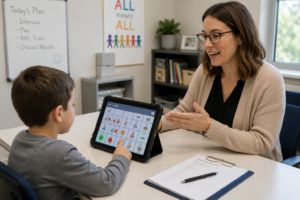 to communicate, in which settings, and with whom
 - Language and cognitive skills: Current understanding of language, symbol use, and how the person learns best
- Motor access: How the person can physically select or point to what they want to say, whether by hand, eye gaze, or another method
- Sensory abilities: Vision and hearing, since these affect which type of system will work
- Positioning and seating: Whether the person’s current seating supports stable, comfortable device access (Coan-Brill et al., 2025)
The review found that access, meaning how a person physically operates their system, made up a large share of everything assessed. This confirms that a good AAC evaluation is not just about picking a device. It is about matching a system to the whole person (Coan-Brill et al., 2025).
6. Funding and Device Abandonment
Getting a high-tech AAC device paid for can be a long process. Devices are often obtained through insurance or a funding body only after a formal evaluation, and this negotiation process can take months. An estimated 97 million people worldwide have complex communication needs and could benefit from AAC, which gives a sense of how large this access gap can be (Smidt & Pebdani, 2023).
A common concern in the field is device abandonment, when a person stops using an AAC system they were given. A 2023 paper proposed reframing how this is understood. Rather than treating unused devices as a failure or a sign the person gave up, the authors argue that people with AAC needs are constantly and reasonably choosing whichever mode of communication, speech, gesture, a low-tech board, or a high-tech device, fits the moment. Using a device inconsistently is not necessarily a problem to fix. It can reflect a person exercising real choice over how they communicate (Smidt & Pebdani, 2023).
7. Speech Therapy for AAC
Speech-language pathologists typically lead the AAC process. They assess how a person currently communicates, what they want to communicate, and which type of system fits best. A 2023 systematic review found that AAC interventions helped minimally verbal children with autism make real gains in social communication, requesting, and speech production. High-tech tools, like speech generating devices, tended to work better than low-tech tools for building social communication and speech (Aftab et al., 2023).
A related meta-analysis pooled data from 114 single-case studies of AAC use in children with autism or intellectual disability. It found that AAC interventions produced meaningful gains in communication overall, though results varied a lot between studies. Age, prior communication mode, and prior imitation skills did not clearly predict who would benefit more, meaning AAC is worth trying broadly rather than only for a narrow group of children (Ganz et al., 2023).
In school settings, a systematic review of AAC teaching strategies in inclusive classrooms found that every included study reported positive outcomes for students with significant intellectual disabilities and complex communication needs (O’Regan Kleinert et al., 2023).
8. Occupational Therapy and Physical Therapy: Positioning and Access
AAC is not only about the device. A person also needs to be able to physically reach it. This is where occupational therapy and physical therapy come in.
A 2025 qualitative study interviewed 13 related service providers, including OTs, PTs, and SLPs, at a school for children who use AAC. Positioning came up as one of the most important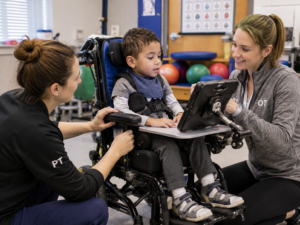 roles OTs and PTs play. One physical therapist explained that some students use all their energy just to participate, so good positioning matters so they do not have to work to hold up their head or trunk while trying to communicate. An occupational therapist in the same study described her role as figuring out how each child can best access literacy and communication tools, whether through typing, pictures, or other adapted methods (Caron et al., 2025).
A 2025 scoping review looked specifically at how AAC assessments are done for children with limited speech and motor skills. It found that most of the 171 assessment practices identified were related to access, meaning how the child physically selects or points to what they want to say. This confirms that positioning and motor access are not a side issue in AAC. They are central to whether a system works at all (Coan-Brill et al., 2025).
9. AAC for Aphasia After Stroke
Aphasia is a language disorder that can happen after a stroke. It can affect a person’s ability to speak, understand language, read, or write. AAC can help fill these gaps.
A 2025 hospital-based randomized controlled trial in China tested whether adding low-tech AAC to standard aphasia treatment improved outcomes for people recovering from a stroke. The study found that combining low-tech AAC with regular speech therapy showed promising early results for communication in this group, supporting AAC as part of stroke rehabilitation rather than something used only after other treatments have been tried (Huang et al., 2025).
10. AAC for ALS
ALS, or amyotrophic lateral sclerosis, is a progressive disease that gradually weakens the muscles used for speech. Because of this, the right time to introduce AAC is a key clinical question.
A 2026 systematic review looked at 28 studies on the timing of communication and technology support for people with ALS. It found that the need for a communication aid typically starts between one and five years after diagnosis, though this varies a great deal depending on where in the body ALS symptoms begin. The review also found a clear link between changes in someone’s speaking rate and later declines in how clearly they can be understood, which can help guide when to start the AAC conversation (Judge et al., 2026).
11. The Role of Communication Partners
AAC does not work in isolation. It depends on the people around the AAC user, known as communication partners. This includes family members, teachers, and caregivers.
A 2023 mixed methods systematic review looked at the experiences of communication partners supporting adults with severe or profound intellectual disability who use AAC. It found that a shared commitment to communication partnership is essential for AAC to work well. At the same time, the review found a disconnect between how communication partners understood their own roles and responsibilities, suggesting that partners often need more guidance and support than they currently receive (Hanley et al., 2023).
12. Team Collaboration in Schools
AAC works best when providers work as a team rather than in separate silos. A 2025 focus group study of school-based OTs, PTs, and SLPs found that collaboration was central to supporting literacy and communication for students who use AAC. Related service providers described sharing goals, coordinating consistent approaches across sessions, and learning from each other’s areas of expertise. Challenges included limited time, inconsistent curricula across classrooms, and a general lack of training in how to support literacy for AAC users (Caron et al., 2025).
13. What Patients and Families Can Do
- Ask for a full team evaluation that includes SLP and, when motor or seating challenges are present, OT and PT as well
- Be patient with the process. Finding the right AAC system can take time and some trial and error
- Practice being a communication partner. Give the person time to respond, and follow their lead rather than rushing them (Hanley et al., 2023)
- Bring up positioning if the person seems to struggle physically with their device, not just if the device itself seems wrong (Coan-Brill et al., 2025)
- Do not wait to introduce AAC out of concern it will delay speech. The evidence does not support that worry, even in very young children (Leonet et al., 2022)
- Know that AAC needs can change over time, especially with progressive conditions like ALS, so revisit the plan as needs shift (Judge et al., 2026)
14. A Note for Clinicians
AAC research spans a wide range of populations and study designs, from single-case studies in children with autism to randomized trials in stroke survivors. This makes it hard to draw one simple conclusion about what works best. What does come through consistently is that access and positioning are not separate from communication goals. They are part of them. OTs and PTs are not peripheral to AAC. Their input on seating, motor access, and material adaptation directly affects whether a communication system can be used at all (Coan-Brill et al., 2025; Caron et al., 2025).
Communication partner training also deserves more attention than it often receives. Devices and systems are only as effective as the people supporting the person who uses them (Hanley et al., 2023). Finally, the myth that AAC delays speech remains common among families and some professionals despite a lack of supporting evidence, even in the youngest children studied. Addressing this concern directly and early in the evaluation process can reduce delays in starting AAC (Leonet et al., 2022).
15. When to Seek a Referral
Consider requesting a referral for an AAC evaluation if:
- Speech is not meeting the person’s daily communication needs
- A child is not developing expected speech and language milestones
- A stroke, ALS diagnosis, or other condition has changed someone’s ability to speak
- An existing AAC device is not being used successfully, which may point to a positioning or access issue rather than the device itself
Related Pages on TherapyTopics
References
- Aftab, A., Sehgal, C. A., Noohu, M. M., & Jaleel, G. (2023). Clinical effectiveness of AAC intervention in minimally verbal children with ASD: A systematic review. NeuroRegulation, 10(4), 239. https://doi.org/10.15540/nr.10.4.239
- Caron, J. G., Babb, S., Stokes, H., Holyfield, C., & Romano, N. (2025). “It’s a lot of collaboration”: Related service providers supporting literacy instruction for learners who use augmentative and alternative communication. Language, Speech, and Hearing Services in Schools, 56(4), 970–985. https://doi.org/10.1044/2025_LSHSS-24-00034
- Coan-Brill, J., Teachman, G., Costigan, F. A., Pham, T., & Cunningham, B. J. (2025). Exploring augmentative & alternative communication assessment practices for children with limited functional speech & motor skills: A scoping review utilizing the Participation Model of AAC. Disability and Rehabilitation: Assistive Technology, 20(5), 1272–1295. https://doi.org/10.1080/17483107.2025.2454253
- Ganz, J. B., Pustejovsky, J. E., Reichle, J., Vannest, K. J., Foster, M., Pierson, L. M., Wattanawongwan, S., Bernal, A. J., Chen, M., Haas, A. N., Liao, C.-Y., Sallese, M. R., Skov, R., & Smith, S. D. (2023). Participant characteristics predicting communication outcomes in AAC implementation for individuals with ASD and IDD: A systematic review and meta-analysis. Augmentative and Alternative Communication, 39(1), 7–22. https://doi.org/10.1080/07434618.2022.2116355
- Hanley, E., Martin, A.-M., Dalton, C., & Lehane, E. (2023). Communication partners’ experiences of communicating with adults with severe/profound intellectual disability through augmentative and alternative communication: A mixed methods systematic review. Journal of Intellectual Disabilities, 27(4), 1107–1134. https://doi.org/10.1177/17446295221115914
- Huang, L., Yan, J., & Chen, S.-H. K. (2025). Combining low-technology augmentative and alternative communication with regular aphasia treatment: Interim findings of a hospital-based RCT in post-stroke patients. Aphasiology, 39(8), 1144–1163. https://doi.org/10.1080/02687038.2024.2406592
- Judge, S., Ballesteros, K., McDermott, C., & Bloch, S. (2026). Timing of communication and technology control support in ALS: A systematic review. Amyotrophic Lateral Sclerosis and Frontotemporal Degeneration. https://doi.org/10.1080/21678421.2026.2627899
- Leonet, O., Orcasitas-Vicandi, M., Langarika-Rocafort, A., Idoiaga Mondragon, N., & Roman Etxebarrieta, G. (2022). A systematic review of augmentative and alternative communication interventions for children aged from 0 to 6 years. Language, Speech, and Hearing Services in Schools, 53(3), 894–920. https://doi.org/10.1044/2022_LSHSS-21-00191
- Lillehaug, H. A., Klevberg, G. L., & Stadskleiv, K. (2023). Provision of augmentative and alternative communication interventions to Norwegian preschool children with cerebral palsy: Are the right children receiving interventions? Augmentative and Alternative Communication, 39(4), 219–229. https://doi.org/10.1080/07434618.2023.2212068
- O’Regan Kleinert, J., Kearns, J. F., Page, J. L., & Kleinert, H. L. (2023). Promising strategies for teaching augmentative and alternative communication in inclusive educational settings: A systematic review. Language, Speech, and Hearing Services in Schools, 54(4), 1333–1357. https://doi.org/10.1044/2023_LSHSS-22-00178
- Smidt, A., & Pebdani, R. N. (2023). Rethinking device abandonment: A capability approach focused model. Augmentative and Alternative Communication, 39(3), 198–206. https://doi.org/10.1080/07434618.2023.2199859
© 2026 TherapyTopics. All information on this page is presented as informational only and is not a replacement for medical recommendations, advice, therapy evaluation, diagnosis, or treatment.