


Key Takeaways
- Sciatica is spinally referred leg pain caused by irritation or compression of a lumbar nerve root, most often from a herniated disc (Dove et al., 2023).
- Reported annual incidence varies enormously by occupation, from about 3 per 1,000 healthcare workers to over 200 per 1,000 among some heavy-equipment operators (Hincapié et al., 2025).
- Modifiable risk factors include smoking, higher BMI, occupational lumbar load from bending and manual handling, whole-body vibration, and prolonged sitting (Hincapié et al., 2025).
- Most people improve with conservative (non-surgical) care; surgery is generally reserved for symptoms persisting beyond 3 to 12 months or for red-flag findings (Liu et al., 2023).
- Evidence on physical therapy’s effectiveness for pain and disability is mixed overall, though it may offer a modest long-term benefit for pain over minimal intervention (Dove et al., 2023).
- Occupational therapy addresses the functional side of sciatica: body mechanics, ergonomic modification, and pacing strategies for daily tasks (Thakur et al., 2024).
- A team-based approach combining OT, PT, and chiropractic care is common for managing symptoms while addressing the underlying mechanical cause.
Table of Contents
- What Is Sciatica?
- Causes of Sciatica
- Symptoms and Red Flags
- Risk Factors
- How Sciatica Is Diagnosed
- Who Treats Sciatica?
- Physical Therapy for Sciatica
- Occupational Therapy for Sciatica
- Chiropractic Care for Sciatica
- Surgical vs. Nonsurgical Treatment
- Self-Management and Prevention
- What Patients and Families Can Do
- A Note for Clinicians
- When to Seek a Referral
1. What Is Sciatica?
Sciatica is not a diagnosis on its own; it is a term for pain that radiates along the path of the sciatic nerve, the longest nerve in the body, running from the lower back through the hip and buttock and down each leg. It happens when a nerve root in the lower spine is irritated, compressed, or inflamed, most commonly from a herniated (bulging) disc pressing on the nerve (Dove et al., 2023). Reported prevalence varies widely, from about 1% to over 40% depending on how studies define the condition, reflecting how inconsistently the diagnosis is applied in research (Dove et al., 2023).
Most people improve within weeks to a few months, though a meaningful share of patients, up to about 45% in some cohorts, continue to have symptoms a year or longer after onset (Dove et al., 2023).
2. Causes of Sciatica
The most common cause is a lumbar disc herniation, where the soft inner material of a spinal disc pushes through its outer layer and presses on a nearby nerve root (Liu et al., 2023). This overlaps closely with some causes of low back pain. Other contributors include:
- Spinal stenosis (narrowing of the spinal canal that puts pressure on nerve roots)
- Degenerative disc disease related to normal aging, a process similar to osteoarthritis affecting the joints of the spine
- Spondylolisthesis (a vertebra slipping forward over the one below it)
- Piriformis syndrome, where a muscle deep in the buttock irritates the nerve
- Pregnancy-related changes in posture and ligament laxity
3. Symptoms and Red Flags
Typical symptoms include pain radiating from the lower back or buttock down one leg, often described as sharp, burning, or electric; numbness or tingling along the nerve’s path; and muscle weakness in the affected leg or foot. Symptoms are usually one-sided and can worsen with sitting, coughing, or sneezing.
4. Risk Factors
A 2025 systematic review synthesizing 87 studies identified several factors consistently linked to a higher risk of developing sciatica from a herniated disc (Hincapié et al., 2025):
- Middle age (30 to 50 years): risk was roughly 30% to 80% higher than in younger adults
- Higher BMI, smoking, and cardiovascular risk factors: each associated with modestly increased risk, particularly in women
- Occupational lumbar load: cumulative exposure to forward bending and manual materials handling was one of the strongest work-related risk factors, with risk more than tripled in some studies
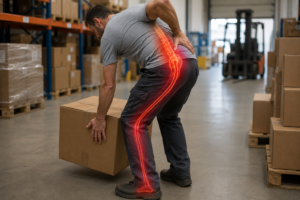
- Whole-body vibration: found in occupations like driving heavy machinery, though the strength of this association varied between studies
- Prolonged sitting combined with vigorous leisure-time activity: associated with increased risk in some cohorts
- Work-related psychosocial factors: higher time pressure and lower decision latitude at work showed weaker but still notable associations
The review’s authors cautioned that most of this evidence carries a moderate risk of bias, and that sciatica likely results from a combination of individual, behavioral, and occupational factors interacting together rather than any single cause (Hincapié et al., 2025).
5. How Sciatica Is Diagnosed
Diagnosis typically starts with a physical exam, including a straight leg raise test (lying down while the examiner raises the affected leg to see if it reproduces the radiating pain) and a check of reflexes, strength, and sensation in the leg. Imaging such as MRI is usually reserved for cases with red-flag symptoms, significant weakness, or symptoms that haven’t improved after several weeks of conservative treatment, since imaging findings don’t always correlate with symptom severity.
6. Who Treats Sciatica?
- Occupational therapy (OT): Ergonomic modification, body mechanics for daily tasks, activity pacing, and adaptive strategies for work and home (Thakur et al., 2024)
- Physical therapy (PT): Exercise prescription, manual therapy, neural mobilization, and movement-based rehabilitation (Dove et al., 2023; Zhu et al., 2025a)
- Chiropractor: Spinal manipulation aimed at improving joint mobility and reducing nerve irritation (Dove et al., 2023; Zhu et al., 2025b)
- Primary care physician: Initial diagnosis, medication management, and referral coordination
- Orthopedic surgeon or neurosurgeon: Surgical evaluation, most often for microdiscectomy, when conservative care hasn’t helped or red flags are present (Liu et al., 2023)
- Pain specialist: Interventional options such as epidural steroid injections for symptoms that haven’t responded to first-line care, part of broader pain management strategies
7. Physical Therapy for Sciatica
Physical therapy is typically the first-line treatment recommended in clinical guidelines, using a combination of exercise, manual therapy, and patient education (Dove et al., 2023). A 2023 systematic review and meta-analysis of 18 randomized trials found no significant difference between physiotherapy and control interventions for pain or disability at short, medium, or long-term follow-up overall, though a subgroup analysis found a modest benefit for pain reduction at the long-term mark when physiotherapy was compared specifically to minimal intervention such as advice alone (Dove et al., 2023). More recent network meta-analyses reached similarly cautious conclusions: for acute and subacute sciatica, interventions such as NSAIDs combined with physical therapy modalities showed the most promise for short-term leg pain relief, though all evidence was rated very low confidence (Zhu et al., 2025a). For chronic sciatica, spinal manipulative therapy and exercise combined with neural mobilization (gentle movements designed to help a nerve glide more freely through surrounding tissue) showed the largest short-term reductions in leg pain, again with very low confidence in the underlying evidence (Zhu et al., 2025b).
Common PT interventions include directional preference exercises, core stabilization, neural mobilization (“nerve glides”), manual therapy, and graded return to activity.
8. Occupational Therapy for Sciatica
While physical therapy addresses the underlying mechanics of sciatica, occupational therapy focuses on restoring the person’s ability to complete daily activities safely and with less pain. OT interventions include ergonomic modification (adjusting a workstation, car seat, or home setup to reduce strain on the lower back), body mechanics training for tasks like lifting, dressing, and bending, 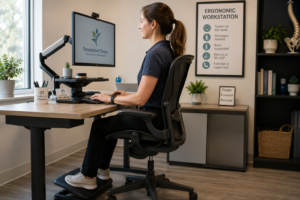 and pacing strategies that help a person balance activity with rest to avoid symptom flare-ups (Thakur et al., 2024). Occupational therapists may also incorporate soft tissue mobilization, therapeutic exercise for core and lower body strength, and modalities such as heat or electrical stimulation as part of a broader functional rehabilitation plan, often working alongside physical therapists and physicians (Thakur et al., 2024).
Because sciatica frequently interferes with sitting, driving, and work tasks, and given how strongly occupational lumbar load predicts sciatica risk in the first place (Hincapié et al., 2025), OT’s role in adapting the home and work environment can be just as important as the exercise-based components of care.
9. Chiropractic Care for Sciatica
Chiropractic care for sciatica centers on spinal manipulation, a hands-on technique intended to improve joint mobility and reduce nerve irritation. Evidence for manipulation specifically is limited: a subgroup analysis found it may modestly reduce pain compared to minimal intervention over the long term, though this conclusion rests on a small number of trials with a high risk of bias (Dove et al., 2023). One trial comparing spinal manipulation to a fake or placebo treatment (a simulated version of the manipulation designed to look and feel similar to the real technique, used so researchers can tell whether the real treatment works better than just going through the motions of one) reported that all participants in the manipulation group had a reduction in radiating pain at both medium and long-term follow-up, compared to roughly 80% in the placebo group, though this single study could not be pooled into the broader meta-analysis due to how its data was reported (Dove et al., 2023). More recent network meta-analysis data similarly points to spinal manipulative therapy as one of the more promising short-term options for chronic sciatica leg pain, alongside exercise with neural mobilization, though again on very low-confidence evidence (Zhu et al., 2025b).
10. Surgical vs. Nonsurgical Treatment
For most people, conservative (nonsurgical) treatment is the recommended starting point, and a 2023 systematic review and meta-analysis found that conservative care led to significant improvements in leg pain and mental and physical quality-of-life scores compared to surgery, while surgery showed an advantage specifically for back pain outcomes (Liu et al., 2023). Surgical options, most often microdiscectomy (removing the portion of disc pressing on the nerve), are generally reserved for people whose symptoms haven’t improved after a trial of conservative treatment, typically 6 to 12 weeks, or for those with red-flag findings such as significant or worsening weakness. When surgery is warranted, it tends to produce faster short-term relief of leg pain than conservative care, though long-term outcomes between the two approaches often even out over time (Liu et al., 2023).
11. Self-Management and Prevention
- Maintaining core and lower back strength through regular, appropriate exercise
- Using proper body mechanics when lifting (bending at the knees, keeping loads close to the body)
- Avoiding prolonged sitting; taking regular movement breaks (Hincapié et al., 2025)

- Setting up an ergonomic workstation, including seat height, monitor position, and lumbar support
- Maintaining a healthy weight and avoiding smoking, both linked to higher risk (Hincapié et al., 2025)
- Staying physically active rather than resting for extended periods once acute pain begins to settle
12. What Patients and Families Can Do
- Ask for a PT or OT referral early if pain hasn’t improved within a few weeks of self-management
- Stay active rather than resting completely; prolonged inactivity tends to slow recovery
- If your job involves heavy lifting, bending, or vibration exposure, ask your OT about workplace modifications, since occupational load is one of the strongest known risk factors (Hincapié et al., 2025)
- Learn to distinguish red-flag symptoms (described above) from ordinary flare-ups, and know when to seek emergency care versus a routine appointment
- Understand that imaging isn’t always necessary; many people improve without ever needing an MRI
13. A Note for Clinicians
The evidence base for sciatica treatment remains notably heterogeneous. Diagnostic criteria differ substantially across trials, spanning self-reported leg pain, positive neurodynamic testing, and imaging-confirmed nerve compression, which complicates comparison across the literature (Dove et al., 2023). Recent network meta-analyses of nonsurgical interventions for both acute/subacute and chronic sciatica found only very low-confidence evidence for most treatments, reflecting small trials, inconsistent outcome reporting, and high risk of bias across the field (Zhu et al., 2025a; Zhu et al., 2025b). Given this, individualizing treatment to the patient’s presentation, and setting realistic expectations about the strength of the evidence, is more defensible than presenting any single modality as clearly superior.
Occupational risk factor data supports early attention to job demands, particularly cumulative lumbar load from bending and manual handling, as one of the more consistently replicated associations in the literature (Hincapié et al., 2025). This makes OT referral for ergonomic and functional assessment a reasonable early step for working-age patients, alongside PT’s exercise-based approach.
14. When to Seek a Referral
Consider requesting a referral to OT, PT, or a physician if:
- Leg pain, numbness, or weakness has lasted more than a few weeks despite rest and activity modification
- Pain is interfering with work, sleep, or daily tasks like dressing, driving, or household chores
- Your job involves heavy lifting, prolonged bending, or vibration exposure
- You notice any red-flag symptoms described above, which warrant immediate emergency evaluation rather than a routine referral
- You’ve completed a course of physical therapy without improvement and want a physician evaluation for imaging or other next steps
Also See
References
- Dove, L., Jones, G., Kelsey, L. A., Cairns, M. C., & Schmid, A. B. (2023). How effective are physiotherapy interventions in treating people with sciatica? A systematic review and meta-analysis. European Spine Journal, 32(2), 517–533. https://doi.org/10.1007/s00586-022-07356-y
- Hincapié, C. A., Kroismayr, D., Hofstetter, L., Kurmann, A., Cancelliere, C., Rampersaud, Y. R., Boyle, E., Tomlinson, G. A., Jadad, A. R., Hartvigsen, J., Côté, P., & Cassidy, J. D. (2025). Incidence of and risk factors for lumbar disc herniation with radiculopathy in adults: a systematic review. European Spine Journal, 34(1), 263–294. https://doi.org/10.1007/s00586-024-08528-8
- Liu, C., Ferreira, G. E., Abdel Shaheed, C., Chen, Q., Harris, I. A., Bailey, C. S., Peul, W. C., Koes, B., & Lin, C. C. (2023). Surgical versus non-surgical treatment for sciatica: systematic review and meta-analysis of randomised controlled trials. BMJ, 381, e070730. https://doi.org/10.1136/bmj-2022-070730
- Thakur, S., Kumar, A., Dijkstra, A., & Thakur, A. (2024). Occupational therapy‐based rehabilitation of sciatic nerve pain. Brain‐X, 2(4), e70010. https://doi.org/10.1002/brx2.70010
- Zhu, Z., Schouten, T., Strijkers, R., Koes, B., Chiarotto, A., & Gerger, H. (2025a). Effectiveness of nonsurgical interventions for patients with acute and subacute sciatica: A systematic review with network meta-analysis. Journal of Orthopaedic & Sports Physical Therapy, 55(6), 1–12. https://doi.org/10.2519/jospt.2025.13068
- Zhu, Z., Schouten, T., Strijkers, R., Koes, B., Gerger, H., & Chiarotto, A. (2025b). Effectiveness of non-surgical interventions for patients with chronic sciatica: A systematic review with network meta-analysis. The Journal of Pain, 33, 105431. https://doi.org/10.1016/j.jpain.2025.105431
© 2026 TherapyTopics. All information on this page is presented as informational only and is not a replacement for medical recommendations, advice, therapy evaluation, diagnosis, or treatment.