


Key Takeaways
- Visual perceptual processing is the brain’s ability to interpret visual information — and it’s separate from eyesight. A person can have 20/20 vision and still have significant visual perceptual difficulties.
- Standardized OT assessments such as the TVPS-4 (Test of Visual Perceptual Skills, Fourth Edition) examine seven visual-perceptual skill areas — discrimination, memory, spatial relationships, form constancy, sequential memory, figure-ground, and closure.
- Visual perceptual difficulties can emerge during childhood development or following stroke or brain injury, affecting daily activities across the lifespan.
- Up to 70% of stroke survivors may experience some form of perceptual difficulty, depending on lesion location and the type of deficit assessed (Hazelton et al., 2022).
- OT, PT, SLP, and optometry each approach visual perceptual processing differently — daily task performance, balance and mobility, AAC symbol access, and visual system function, respectively.
- Emerging research suggests that selected OT interventions may improve visual-perceptual skills in children. Whether those improvements consistently carry over into daily activities — handwriting, self-care, school performance — is still being studied.
- Vestibular rehabilitation — exercises that train the balance and visual systems to work together — has systematic review and meta-analytic support for improving balance and gait after stroke (Meng et al., 2023).
- AAC display design — symbol size, spacing, and background contrast — affects how reliably someone with developmental disabilities can locate and select symbols (Wilkinson et al., 2021).
Important: Visual perceptual processing is not the same as visual acuity. An optometrist or ophthalmologist assesses whether the eyes see clearly. An OT assesses how the brain processes and interprets what the eyes see. Both evaluations may be needed when visual concerns are present. If a child or adult hasn’t had a recent eye exam, that should happen before or alongside a visual perception evaluation.
Note for clinicians: The TVPS-4 (2017) is the current edition used in clinical practice. The TVPS-3 is referenced on this page where cited research used it as an outcome measure (Wu et al., 2022); for assessment, use the TVPS-4.
What the Evidence Does — and Does Not — Show
Research supports assessment and treatment of visual-perceptual difficulties when they interfere with daily activities. Some studies have found improvements in visual-perceptual test scores following targeted interventions. But improvement on a visual-perceptual test does not automatically mean that reading, handwriting, self-care, or other everyday activities will improve. Therapy should connect identified visual-perceptual difficulties to meaningful functional goals — not just aim to raise scores.
Understanding the Research
This page cites several types of research studies. A randomized controlled trial (RCT) compares two or more interventions, with participants randomly assigned to groups, to determine which produces better outcomes. A systematic review combines and critically evaluates all available studies on a topic. A meta-analysis goes a step further, statistically pooling results across studies to produce an overall estimate of effect. Each type of study has strengths and limitations — being a systematic review, for example, does not guarantee that the evidence is strong if the underlying studies are limited.
Contents
- What Is Visual Perceptual Processing?
- The Seven Components of Visual Perception
- Visual Perceptual Processing and Optometry
- Visual Perceptual Processing and Occupational Therapy
- Visual Perceptual Processing and Physical Therapy
- Visual Perceptual Processing and Speech-Language Pathology
- When to Request a Referral
- References
1. What Is Visual Perceptual Processing?
Visual perceptual processing is the brain’s ability to receive, organize, and interpret visual information from the environment. It goes well beyond eyesight. Vision is what the eyes detect — visual perceptual processing is how the brain makes meaning from that input. Recognizing letters, understanding spatial relationships, recognizing an object from different angles, finding a cup on a cluttered shelf: all of that is visual perceptual processing.
These difficulties can appear during childhood development or after a neurological event such as stroke or traumatic brain injury. In children, they often show up in handwriting, math, and self-care. In adults, they frequently emerge after stroke and affect independence in daily tasks, driving, and community mobility (Carsone et al., 2021; Hazelton et al., 2022).
OTs focus on daily task performance and perceptual skill development. PTs address how vision and the vestibular system (the inner ear’s balance center) work together for balance and gait. SLPs consider how visual attention and processing affect communication and AAC access. Optometrists assess and treat the underlying visual system functions that support perceptual processing.
2. The Seven Components of Visual Perception
Standardized tools such as the TVPS-4 organize visual perception into seven measurable components — an assessment framework that helps clinicians identify areas of difficulty. OTs, PTs, and SLPs each work with one or more of these areas, depending on their clinical focus:
- Visual discrimination: identifying differences and similarities between shapes, letters, symbols, or objects. Someone with difficulty here may struggle to distinguish similar-looking medication labels, tell apart traffic signs, or identify subtle differences between symbols on an AAC device.
- Visual memory: recalling a visual image accurately after it is no longer in view. This shows up when copying from a board or screen — you have to hold the image in mind while looking down to write — or when trying to recall how items were arranged on a shelf.
- Spatial relationships: understanding the position of objects in space relative to oneself and each other. Difficulty here can appear as trouble lining up numbers in a math problem, misjudging distances when reaching or parking, or misreading a map.
- Form constancy: recognizing a shape or letter regardless of changes in size, position, or color. A person with difficulty here may not recognize the letter “A” in an unfamiliar font, or may fail to identify a familiar object when seen from a different angle.
- Sequential memory: recalling a series of visual images in the correct order. This affects tasks like reproducing a sequence of shapes or colors after the original is removed, or following step-by-step visual instructions when the steps must be held in mind while being carried out.
- Figure-ground: identifying a specific object or form within a complex or busy visual background. This can look like difficulty finding a word on a cluttered page, locating an item on a grocery shelf, or spotting a pill bottle among other items in a cabinet.
- Visual closure: recognizing a complete image or word when only part of it is visible. A person with difficulty here may not recognize a familiar word unless every letter is fully visible, or may struggle to identify an object that is partially hidden.
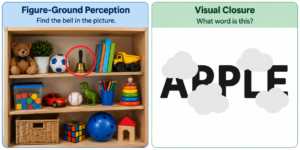
These seven components are relevant across OT, PT, and SLP practice. Standardized test results should always be interpreted alongside direct observation of how the person actually performs in daily activities — a score alone doesn’t tell the full story.
The TVPS-4 and the Motor-Free Visual Perception Test (MVPT-4) are among the most widely used standardized tools in OT practice. The MVPT-4 is designed to assess visual perception independently of motor ability — useful when motor impairments might otherwise affect the results.
3. Visual Perceptual Processing and Optometry
Optometrists assess and treat disorders of the visual system that affect how the brain processes what the eyes see. A standard eye exam determines whether the eyes see clearly. A comprehensive optometric evaluation can identify difficulties with eye tracking (following a moving target), convergence (coordinating both eyes to work together), accommodation (shifting focus between near and far), and visual-perceptual processing. Two specialty areas of optometry are particularly relevant here: developmental optometry and neuro-optometry.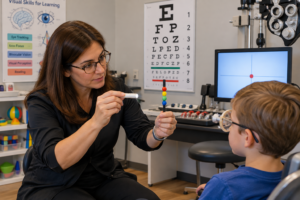
Developmental optometrists may evaluate visual functions such as eye teaming, focusing, tracking, and visual processing, and may provide vision therapy — a structured program of visual activities supervised by an optometrist — when indicated. Visual and motor development are closely related during childhood, which supports interdisciplinary assessment when visual concerns accompany developmental or functional difficulties (Sánchez-González et al., 2022).
Neuro-optometrists specialize in acquired visual disorders following neurological events such as stroke or traumatic brain injury, and may offer office-based or home-based rehabilitation programs targeting eye movement difficulties. A 2024 systematic review examining neuro-optometric rehabilitation in adults found that the available research is limited, and additional high-quality studies are needed before firm conclusions about effectiveness can be drawn (Jose et al., 2024).
Optometrists often work alongside OTs, PTs, and SLPs when visual difficulties affect daily function. An optometric evaluation may be recommended before or alongside a visual perception OT evaluation — particularly when eye movement disorders, focusing difficulties, or convergence problems may be contributing to a child’s or adult’s functional challenges.
For Patients and Families: Optometry and Visual Perceptual Processing
- A standard eye exam checks whether your eyes see clearly — it doesn’t assess how the brain processes visual information. If visual perceptual concerns are present, a developmental or neuro-optometric evaluation may give you more to work with.
- For children with learning difficulties, a developmental optometrist can assess tracking, focusing, eye teaming, and visual-perceptual skills to determine whether visual system issues may be contributing to challenges in school.
- For adults following stroke or brain injury, neuro-optometric rehabilitation may address eye movement and visual processing difficulties that affect reading, mobility, and daily independence. Research in this area is developing, and a specialist can advise on whether it is appropriate for your situation (Jose et al., 2024).
- An optometrist and an OT often work as a team when both visual system function and daily task performance are affected.
For Clinicians: Optometry Practice Considerations
- Refer to a developmental optometrist when a child presents with visual-perceptual or visual-motor difficulties that may have an underlying oculomotor or binocular vision component — particularly convergence insufficiency, tracking deficits, or unstable accommodation.
- Neuro-optometric evaluation may be appropriate for adults post-stroke or post-TBI when visual field deficits, diplopia (double vision), or oculomotor impairments are present alongside or distinct from higher-level visual-perceptual processing deficits. The evidence base for neuro-optometric rehabilitation in adults is limited; refer based on individual clinical presentation (Jose et al., 2024).
- Coordinate OT and optometry scopes carefully: optometrists address visual system function; OTs address how perceptual deficits affect participation in daily activities. Both evaluations may be indicated and are complementary.
- Visual system assessment results — tracking, convergence, field testing — can inform OT evaluation and treatment planning, particularly when visual-perceptual test scores don’t align with observed functional performance.
4. Visual Perceptual Processing and Occupational Therapy
Occupational therapists assess and treat visual perceptual processing across the lifespan, with a focus on how perceptual difficulties affect independence in daily activities. In children, this includes handwriting, copying tasks, self-care, and participating in classroom activities. In adults, OT addresses how visual-perceptual impairments after stroke or brain injury limit performance of daily tasks, functional mobility, and community participation.
Visual-motor integration — the coordination of visual perception with motor output — is a key area of OT assessment in pediatric populations. Children with developmental disabilities show significant variation in visual-motor scores by age, sex, and diagnosis, which means evaluations and goals need to be individualized (Carsone et al., 2021).
An RCT involving 23 children with developmental disabilities found that adding interactive digital games to conventional rehabilitation significantly improved overall visual-perceptual test scores compared with conventional rehabilitation alone (Wu et al., 2022). The results are encouraging, but this was a small study. We still don’t know whether better scores on a visual perception test lead to meaningful changes in what children can do day to day.
Children with developmental dyslexia who received visual perception-based OT showed improvements in fine motor performance and perceptual skill scores, with some reading-related gains also reported (Köse et al., 2024). That said, dyslexia is primarily a language-based reading disorder, and visual-perceptual exercises have not consistently demonstrated improvements in reading accuracy or comprehension. The evidence for reading gains remains limited. Visual perception-based OT should complement — not replace — structured literacy instruction that addresses phonological awareness (the ability to recognize and work with the sounds in words) and decoding skills.
Adults who develop perceptual disorders following stroke are a core OT population. Visual neglect — difficulty attending to one side of the visual field — along with spatial perception deficits and figure-ground difficulties can significantly affect daily independence. Up to 70% of stroke survivors may experience some form of perceptual difficulty, depending on lesion location and the type of deficit assessed. A Cochrane systematic review examined interventions for perceptual disorders following stroke — not including visual neglect or visual field deficits, which were considered separately — and found insufficient evidence to determine the effectiveness of the interventions reviewed, while calling for additional research (Hazelton et al., 2022). Occupational therapists may use compensatory strategies, environmental modifications, and targeted rehabilitation to address these challenges.
In OT, the goal isn’t simply to improve a score on a visual perception test. What matters is whether the difficulty is getting in the way of something the person needs to do — and OT doesn’t need to eliminate the underlying perceptual deficit to improve participation. Adapting the environment, modifying task demands, or providing compensatory strategies can meaningfully improve a person’s ability to function even when the perceptual impairment itself remains. A child who has difficulty finding information on a worksheet may benefit from reduced visual clutter, highlighted instructions, and systematic scanning strategies. An adult recovering from stroke may practice locating objects during meal preparation, organizing medications, or navigating familiar environments. These approaches connect visual-perceptual rehabilitation directly to meaningful daily life.
For Patients and Families: Visual Perceptual Processing in OT
- An OT may assess specific visual-perceptual skill areas using standardized tools such as the TVPS-4 or MVPT-4, along with observation of how visual-perceptual difficulties affect everyday activities.
- Therapy may include tabletop activities, digital game tasks, and functional practice in handwriting or daily tasks — all targeting specific perceptual components (Wu et al., 2022).
- For school-age children with dyslexia or learning differences, visual perception-based OT has shown improvements in motor skills and perceptual test scores. It works best alongside literacy instruction that addresses phonological awareness and decoding (Köse et al., 2024).
- OT for visual perception after stroke focuses on daily activities such as finding objects, navigating familiar environments, and managing daily routines. When the underlying perceptual difficulty cannot be fully remediated, environmental modifications and compensatory strategies can still significantly improve participation (Hazelton et al., 2022).
For Clinicians: OT Practice Considerations
- Differentiate between visual acuity deficits (refer to optometry) and visual perceptual processing deficits (OT scope) before initiating intervention; both evaluations may be indicated.
- The TVPS-4 provides subtest-level information across seven perceptual components. Interpret these findings alongside functional observations to identify areas that may be contributing to occupational performance difficulties and inform intervention planning.
- Separate motor-free visual perception assessment (MVPT-4) from visual-motor integration assessment (Beery VMI) to distinguish perceptual from motor contributions to task performance (Carsone et al., 2021).
- RCT evidence supports technology-assisted and game-based interventions for improving visual perceptual skill scores in children with developmental disabilities; transfer to everyday activities requires further study (Wu et al., 2022).
- Visual perception-based OT programs have RCT evidence for improving fine motor and perceptual outcomes in children with dyslexia; evidence for reading gains is more limited and should not be overstated (Köse et al., 2024).
- For adults post-stroke, distinguish between visual neglect, visual field deficits, and higher-level perceptual disorders — Hazelton et al. (2022) addresses the latter specifically. Compensatory and environmental approaches are appropriate when restorative gains are limited.
5. Visual Perceptual Processing and Physical Therapy
Physical therapists address visual perceptual processing primarily through visual-vestibular integration — the coordination of the visual system, vestibular system (the inner ear’s balance center), and proprioception (the body’s sense of its own position in space) for postural control, balance, and gait. When this coordination is disrupted following neurological injury, visual perception becomes a key factor in rehabilitation.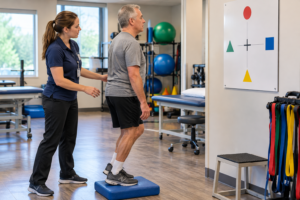
Vestibular rehabilitation — which includes gaze-stability exercises and visual-motor coordination tasks — is an evidence-based component of post-stroke physical therapy. A systematic review and meta-analysis of 15 RCTs found significant improvements in balance and gait outcomes with this approach (Meng et al., 2023).
For stroke survivors with visual field deficits, VR-based visual perceptual learning is an area of active investigation. A 2024 RCT found that participants in both the experimental and control groups demonstrated improvements in visual field measurements, but the differences between groups were not statistically significant — both groups received forms of visual training. The findings are encouraging, and additional research is needed to establish effectiveness (Namgung et al., 2024). It’s also worth noting that visual field deficits and visual-perceptual processing disorders are distinct conditions: visual field loss affects what a person can see; visual-perceptual processing affects how the brain interprets what is seen. Both can interfere with mobility, environmental awareness, and daily activities — and both may require coordinated rehabilitation.
See also: Fall Prevention and Stroke Recovery for more on how visual deficits interact with mobility and rehabilitation outcomes.
For Patients and Families: Visual Perceptual Processing in PT
- A PT may assess how well your visual system and balance system work together during standing, walking, and movement tasks.
- Gaze-stability exercises, balance training on uneven surfaces, and VR-based activities may be used to improve visual-vestibular coordination and reduce fall risk (Meng et al., 2023).
- If you have a visual field deficit after stroke, VR-based approaches are being studied as a rehabilitation option. Ask your PT or physician whether this type of program is appropriate for your situation (Namgung et al., 2024).
- PT may coordinate with OT and optometry when visual perceptual difficulties affect mobility, safety, and daily function.
For Clinicians: PT Practice Considerations
- Include visual-vestibular integration screening as part of balance and gait evaluation for individuals post-stroke and post-TBI, particularly when fall risk or spatial disorientation is present.
- Vestibular rehabilitation protocols incorporating gaze-stability and visual-motor components are supported by systematic review and meta-analytic evidence for improving balance and gait outcomes post-stroke (Meng et al., 2023).
- VR-based approaches for visual field rehabilitation following stroke show promise in early trials but have not yet demonstrated statistically significant between-group superiority; consider alongside established vestibular and perceptual rehabilitation approaches (Namgung et al., 2024).
- Distinguish between visual field loss (neurological, may require neuro-optometry) and higher-level visual perceptual processing deficits (OT scope) when determining referral and co-treatment needs.
- Coordinate with OT for functional daily activity implications of visual perception and visual field deficits identified during PT evaluation.
6. Visual Perceptual Processing and Speech-Language Pathology
Speech-language pathologists encounter visual perceptual processing in the context of augmentative and alternative communication (AAC) — tools and strategies that help people communicate when speech is limited or absent — and literacy. For AAC users, visual attention and visual discrimination directly affect how effectively someone locates, identifies, and selects symbols on a communication display. For children developing literacy, visual perceptual skills support letter recognition, word identification, and reading fluency.
Research using eye-tracking technology has demonstrated that individuals with developmental disabilities can direct visual attention toward cued symbols within complex AAC displays. These findings have clinical implications for how SLPs design displays and conduct individualized assessment — symbol placement, background contrast, and visual complexity are all variables worth examining systematically for each person (Wilkinson et al., 2021).
Children with CVI (cortical visual impairment — a brain-based visual processing condition that affects how the brain interprets what the eyes see, rather than how clearly the eye sees) and complex communication needs often require input from the SLP, OT, and vision specialist together. Standard AAC displays and strategies may be inaccessible without modification. Adapted AAC strategies may improve communication access and participation for this population, though available research varies in quality and additional studies are needed to identify which approaches are most effective (Quezada et al., 2026).
See also: Augmentative and Alternative Communication (AAC) and Speech and Language Delays in Children.
For Patients and Families: Visual Perceptual Processing and Communication
- If your child uses an AAC device or picture-based communication, how symbols are arranged, sized, and contrasted can affect how easily they find and select the right option. An SLP can assess this and adjust the display to better match your child’s visual processing abilities (Wilkinson et al., 2021).
- For children with cortical visual impairment (CVI), adapted AAC strategies may improve communication access and participation. Research in this area is growing, and a team approach involving SLP, OT, and a vision specialist gives the most complete picture (Quezada et al., 2026).
- SLP, OT, and vision specialists often collaborate when a child has both communication needs and visual perceptual processing difficulties.
For Clinicians: SLP Practice Considerations
- Visual attention to symbol arrays is a clinically distinct concern for AAC users with intellectual, developmental, or visual disabilities; do not assume symbol access is adequate without examining visual attention to the display.
- Eye-tracking research indicates that visual attention to cued targets within AAC displays is an addressable skill; use individualized assessment to determine which display variables — size, spacing, contrast, density — may be limiting reliable access for a given person (Wilkinson et al., 2021).
- Students with CVI and complex communication needs require AAC interventions adapted to their unique visual processing profiles. Collaborate with OT and vision specialists; available evidence varies in quality (Quezada et al., 2026).
- Refer to OT for formal visual perceptual processing assessment when visual discrimination, figure-ground, or visual attention deficits are suspected to be affecting symbol recognition or literacy performance.
- Coordinate with vision specialists (neuro-optometrist, teacher of the visually impaired) when CVI or visual field deficits are present alongside communication needs.
7. When to Request a Referral
When to Request an OT, PT, SLP, or Optometry Referral
Consider an OT referral when:
- A child demonstrates persistent difficulty with visual organization, copying from the board, locating materials, or completing visually demanding classroom tasks despite appropriate instruction and accommodations (Wu et al., 2022).
- A child’s identified visual-perceptual difficulties are affecting handwriting, self-care, or other daily activities (Köse et al., 2024).
- An adult reports changes in visual processing following stroke, TBI, or neurological illness — including difficulty finding objects or navigating familiar environments (Hazelton et al., 2022).
Consider a PT referral when:
- Balance difficulties or increased fall risk are present following stroke or neurological injury, particularly with accompanying visual complaints or dizziness (Meng et al., 2023).
- Visual field deficits following stroke are affecting functional mobility, safe walking, or community independence.
Consider an SLP referral when:
- An AAC user has difficulty selecting symbols consistently or accurately, even when device access is otherwise appropriate (Wilkinson et al., 2021).
- A student with known or suspected CVI has unmet communication needs or is not progressing with current AAC strategies (Quezada et al., 2026).
Consider an optometry referral when:
- A child has not had a comprehensive eye exam before being referred for OT visual perception services, or when an OT evaluation reveals unexplained discrepancies between perceptual test performance and functional observation.
- An adult following stroke or TBI presents with diplopia (double vision), visual field loss, or oculomotor deficits; neuro-optometric evaluation may be appropriate (Jose et al., 2024).
8. References
Carsone, B., Green, K., Torrence, W., & Henry, B. (2021). Systematic review of visual motor integration in children with developmental disabilities. Occupational Therapy International, 2021, Article 1801196. https://doi.org/10.1155/2021/1801196
Hazelton, C., Thomson, K., Todhunter-Brown, A., Campbell, P., Chung, C. S., Dorris, L., Gillespie, D. C., Hunter, S. M., McGill, K., Nicolson, D. J., Williams, L. J., & Brady, M. C. (2022). Interventions for perceptual disorders following stroke. Cochrane Database of Systematic Reviews, 2022(11), Article CD007039. https://doi.org/10.1002/14651858.CD007039.pub3
Jose, J., George, B. M., Bhandary, S. V., & Jasti, D. B. (2024). Impact of neuro-optometric rehabilitation on adult oculomotor challenges: A systematic review. Oman Journal of Ophthalmology, 17(3), 320–324. https://doi.org/10.4103/ojo.ojo_60_24
Köse, B., Temizkan, E., Şahin, S., Kara, K., & Uyanık, M. (2024). Effects of a visual perception-based occupational therapy programme on reading and motor skills in children with developmental dyslexia: Single blind randomised crossover study design. Dyslexia, 30(3), Article e1773. https://doi.org/10.1002/dys.1773
Meng, L. J., Liang, Q., Yuan, J. R., Li, S. Y., Ge, Y. L., Yang, J. Y., Tsang, R. C. C., & Wei, Q. (2023). Vestibular rehabilitation therapy on balance and gait in patients after stroke: A systematic review and meta-analysis. BMC Medicine, 21, Article 322. https://doi.org/10.1186/s12916-023-03029-9
Namgung, E., Kwon, S. U., Han, M.-K., Kim, G.-M., Kim, H. Y., Park, K. Y., Cho, M., Choi, H. G., Nah, H. W., Lim, H. T., & Kang, D.-W. (2024). Digital therapeutics using virtual reality-based visual perceptual learning for visual field defects in stroke: A double-blind randomized trial. Brain and Behavior, 14(5), Article e3525. https://doi.org/10.1002/brb3.3525
Quezada, S., Tuttle, M., Williams, A. N., & Root, J. (2026). Alternative and augmentative communication interventions for students with visual impairment and complex communication needs: A systematic literature review. The Journal of Special Education. Advance online publication. https://doi.org/10.1177/00224669261477749
Sánchez-González, M. C., Palomo-Carrión, R., De-Hita-Cantalejo, C., Romero-Galisteo, R. P., Gutiérrez-Sánchez, E., & Piñero-Pinto, E. (2022). Visual system and motor development in children: A systematic review. Acta Ophthalmologica, 100(7), e1356–e1369. https://doi.org/10.1111/aos.15111
Wilkinson, K. M., Zimmerman, T. O., & Light, J. (2021). Visual attention to cued targets in simulated aided augmentative and alternative communication displays for individuals with intellectual and developmental disabilities. Journal of Speech, Language, and Hearing Research, 64(5), 1726–1738. https://doi.org/10.1044/2021_JSLHR-20-00451
Wu, W.-L., Huang, Y.-L., Liang, J.-M., Chen, C.-H., Wang, C.-C., & Ho, W.-H. (2022). Interactive digital game for improving visual–perceptual defects in children with a developmental disability: Randomized controlled trial. JMIR Serious Games, 10(2), Article e34756. https://doi.org/10.2196/34756